by Silvia Passiflora
Poetry competitions with publishing contracts and monetary prizes often disqualify work that has already appeared online, which means poets actively building a public body of work can find themselves excluded for the very visibility and consistency that demonstrate a serious practice. Work published outside institutional channels is still often categorized separately from traditionally circulated poetry — as though the platform determines the craft, rather than the poem itself. I have nearly 2,000 poems in my archive, years of a living practice, and in the time I would spend navigating that circuit, I could have written another book.
“…as though the platform determines the craft, rather than the poem itself.”
The part many newer poets don't realize is how complicated publication rights can become over time. When journals publish your work, they often retain certain rights for a period, and later, when poets assemble collections, they may need to track down permissions to reprint poems that originated elsewhere. Some publications charge fees. Others disappear entirely, leaving records and permissions difficult to untangle. I built Scriptaluna Press so that situation would never become part of my own publishing history — filed the copyright, secured a unique catalog number from the Library of Congress, established distribution infrastructure, and maintained ownership of the work from the first draft forward.
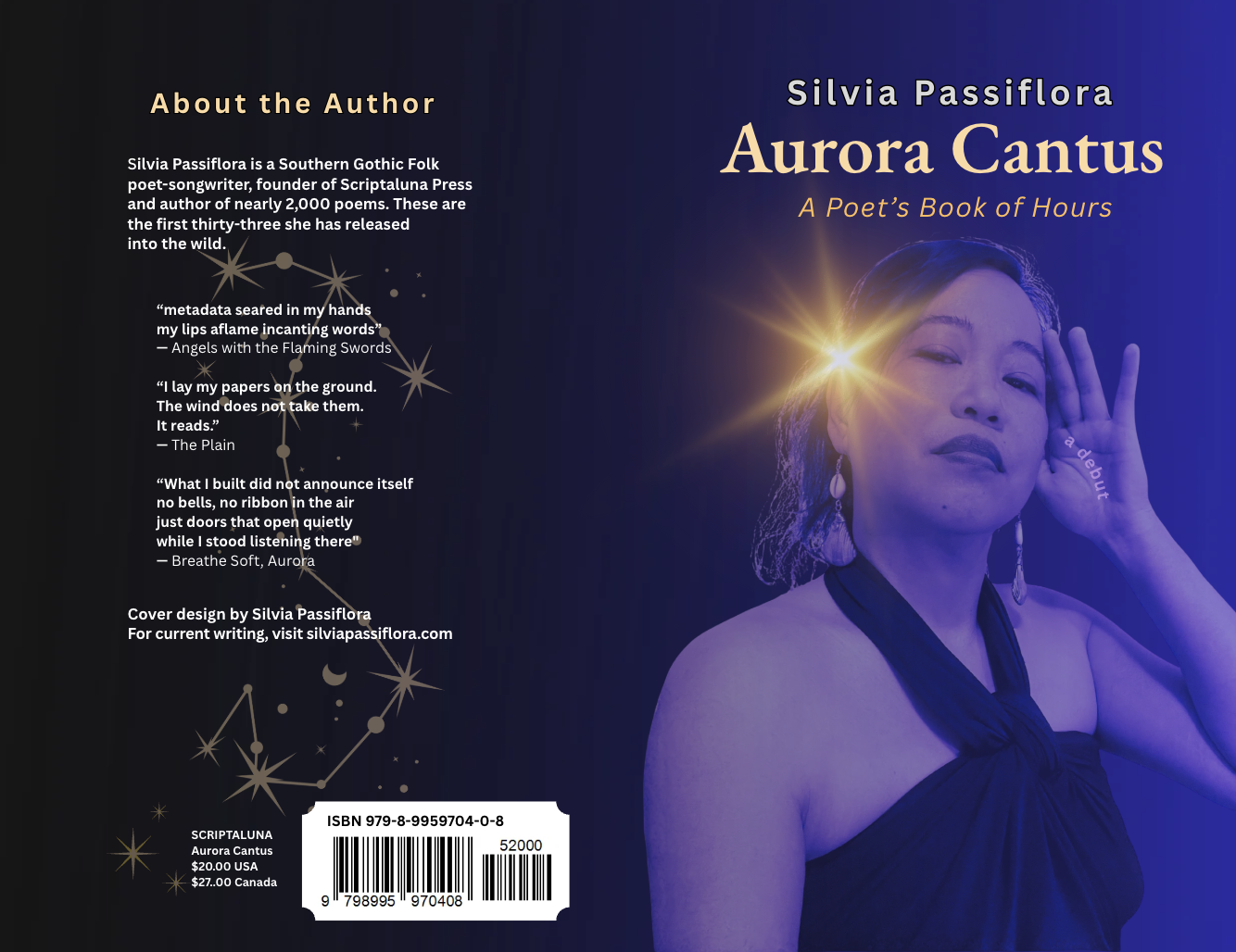
Aurora Cantus wraparound cover — designed by Silvia Passiflora, published by Scriptaluna Press, June 19, 2026.
The traditional path was never designed for the volume of work I create or the pace at which I create it, and eventually I stopped waiting for it to catch up. There is a well-documented history of independently published books later being acquired and reissued by major publishers after the work has already proven itself in the world — after readers have found it, after libraries have cataloged it, after the book has established its own history. That's the trajectory I'm building toward. I'm not opposed to legacy presses; if one wanted to acquire rights to my work, I have the infrastructure to negotiate from a position of ownership.
“I became the entity I would have pursued.”
For more posts about artist independence, visit silviapassiflora.com/blog